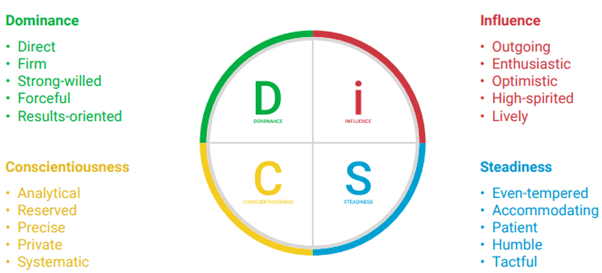
Entrepreneurship is equal parts vision casting/reality checking, resilience, risk management, and daily execution. Startups demand that CEOs wear many hats. From ideation to execution, businesses of one lean heavily on their founder’s strengths. Everyone has natural behavior priorities and blind spots. Everything DiSC® behavior assessment profiles 4 core quadrants (Dominance, Influence, Steadiness, Conscientiousness) and 12 unique blends of these styles. How might your DiSC style impact your entrepreneurial journey?
Certain strengths make a person a natural entrepreneur. Every style’s strengths can contribute to business success, but there are common leadership blind spots that can create unconscious friction in business operations, delegation, attention to detail, and work-life conflict.
By understanding how your natural style may show up in your entrepreneurship or business ownership, strengths and challenges, you can adapt to mitigate risk and leverage strengths.
In this article, we’ll look at the 4 DiSC quadrants (D, i, S, C) through an entrepreneurial lens. We’ll use Everything DiSC’s behavior assessment foundation of four workplace behavioral priorities to help identify:
- Typical strengths each style brings to entrepreneurship.
- Entrepreneurial pitfalls each style may encounter if they don’t adapt their behavior.
D-Style Everything Disc: (Dominance: Result-Oriented, Direct, Decisive)
Drivers lead with a priority for challenge, control, and tangible results. Many entrepreneurs are high-D. Vision casting, quick decision-making, and bulldozing through obstacles are natural for starters and growth hackers.
Strengths — D entrepreneurs are natural risk-takers. They are willing to pivot quickly, don’t fear failure, set big goals, and are comfortable with high stakes. Many renowned entrepreneurs are high D. Audacious. Directive. Winners.
Pitfalls — Details, process, and slow-paced people bore us. As a result, we may miss risks or fail to implement necessary systems. We hate to delegate because we lose control. We may push teams too hard on timelines. It can be difficult for D entrepreneurs to set work-family boundaries with a hyper-focus on winning.
i-Style Everything DiSC: (Influence: People-Oriented, Enthusiastic, Persuasive)
The high-i entrepreneur is driven by social interaction, enthusiasm, and influence. Selling. Fundraising. Championing ideas and employees are natural for the high-i style.
Strengths — Influencers excel at attracting talent and buyers. They are natural motivators and have big-picture selling skills. High-i entrepreneurs are charismatic, thrive with public exposure, and can easily turn clients into fans.
Pitfalls — Does everyone know what they should be doing? i’s can struggle with follow-through and details. We launch a lot of initiatives and struggle to finish things. Delegation is easy but often to the wrong people. We have difficulty telling people “no.” Work-family conflict can occur when networking and social opportunities take over.
S-Style Everything DiSC: (Steadiness: Cooperative, Patient, Supportive)
If you’re high-S, you seek employment harmony, dependability, and loyalty. Building a positive culture and a loyal team is a priority.
Strengths — High-S leaders are talented at retaining top talent and service-oriented businesses. They are exceptional coaches. Patient with slow periods.
Pitfalls — High-stakes risk-taking isn’t our thing. We can be slow to scale or make necessary changes to momentum. We have no problem delegating but, like to go easy on those who aren’t performing. Some details earn too much of our attention because we’re striving for perfect teamwork. Work-family concerns arise when we take on too much team stress or skip boundaries to avoid conflict.
C-Style Everything DiSC: (Conscientiousness: Analytical, Accurate, Systematic)
If you’re high-C you value quality, accuracy, expertise, and working within established systems.
Strengths — Enjoys working within complexity, loves developing systems and processes. Thrives behind the scenes and contributes to technical/business excellence.
Pitfalls — We get paralyzed by details. C entrepreneurs can lose sight of the forest through the trees. Delegation is difficult because we can’t trust others to meet our standards. We avoid making any decision if it hasn’t been researched thoroughly. We work too much and worry about every little thing that could go wrong.
Entrepreneurial Blends & Startup Stages
We all have dominant and secondary styles. For example, Di entrepreneurs are visionary chiefs. SC leaders are steady operators. Learn everything about DiSC for entrepreneurs.
Entrepreneurial stages exacerbate DiSC blind spots because there is little room for delegation in the early goings.
Starting out, High-D/Di entrepreneurs ignore systems and sacrifice details. Expansion means chaos.
High-i/iS entrepreneurs often overpromise and under-deliver behind the scenes. Customers/employees lose trust.
High-S/SC business owners avoid the tough cuts early on, causing inefficiencies to compound over time.
High-C/CD entrepreneurs build flawless products that may not launch at the right time (if at all).
Everything DiSC® color dots indicate how adaptable we are in stretching beyond our priorities. The closer the dot is to the priority icon, the less likely someone with that behavior style is to flex that behavior without feeling drained or unnatural.
The Emotional Exhaustion Connection
A 2018 study by Michael Goldsby at Ball State University published in the Journal of Small Business Management found that role ambiguity (not knowing your responsibilities) and work-family conflict are the leading predictors of emotional exhaustion, which leads to entrepreneur exit plans — even when businesses are profitable. DiSC styles that don’t naturally adapt to address these challenges burn out faster. Entrepreneurs who are high in Dominance hate to delegate, creating ambiguity and workload. Influencers avoid confrontation, leading to delayed performance improvements. High-Steadiness absorbs the burden on their teams. And Conscientiousness entrepreneurs will exhaust themselves trying to make everything perfect.
Understanding your DiSC style can help you understand why startup challenges may be more difficult for you. And what you can do to prevent startup stress from becoming emotional exhaustion leading to your exit.
The Everything DiSC model can help you identify where you’re naturally inclined to thrive as an entrepreneur and where you may need to stretch. Developing awareness of your strengths and blind spots can allow you to seek additional support through mentoring, coaching, and forcing healthy boundaries to counterbalance your natural tendencies.