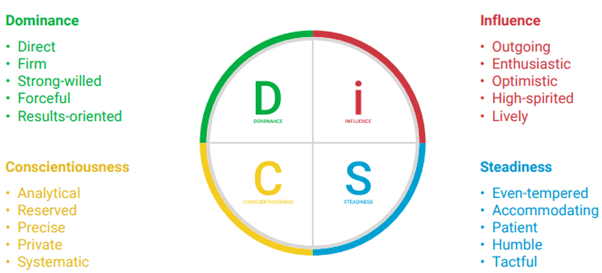
One question we often hear from participants after they complete Everything DiSC® is: “If I take this again in a few months (or years), will I have the same profile?” By ‘profile,’ they mean the location of their priority dot on the DiSC® map and the style label.
The short answer is “Yes!” More specifically, Everything DiSC® profiles are generally stable in the short-term, but small to moderate changes are possible (and even likely) over longer periods of time as you apply a greater sense of self-awareness or, as a result of significant life or work events. The tool is designed to capture how you are prioritizing your responses at this moment. As your responses change, so can your Everything DiSC profile.
Everything DiSC® Is Reliable Over Time
The Everything DiSC® Manual (Chapter 4, published by Wiley) notes: When we administer Everything DiSC twice to the same group of respondents two weeks apart, how do their scores change? Do their overall Everything DiSC profiles remain consistent? When respondents retake Everything DISC® two weeks after their initial test, the correlations between their Scale scores from Time 1 and Time 2 are very high (between .85 and .88 for the eight scales), far exceeding the commonly accepted benchmark for very good reliability of .80. This means the results are robust, though again, in the short-term, as you might expect.

Angle changes between Time 1 and Time 2. Everything DiSC® profiles on the 360° circumplex are even more compelling…. Because there are 12 distinct styles equally spaced around the map, each style is centered within a 30° slice of the circumplex. The median angle change in the sample was only 12°, far below the 90 ° expected if individuals’ dots were placed randomly on the map.
33% of the test sample changed by 7° or less, and 66% changed by 19° or less. Notice too that the dots for individuals who were strongly inclined to one style (i.e., whose vectors were long enough that their dot fell at least halfway between the center of the circle and the edge) were more stable than the dots for those who were not as strongly inclined to one style. For individuals with stronger style tendencies, the median angle change was only 10° compared to 23° for weaker individuals.
Therefore…
Data suggest that the DiSC® scales are stable over repeated administrations…. Researchers and consumers of the Everything DiSC assessment should, on average, expect no more than small changes when the instrument is taken at different times.” – Everything DiSC® Manual, page 63-64
Why Might Your Everything DiSC® Profile Change?
Everything DiSC® assesses your priorities for responding to the people, pace, and procedures you encounter at work. While your personality is wired in a way that makes you naturally prefer working in certain ways, your priorities can and do change—especially as you become more self-aware and learn new ways to respond that feel authentic and effective.
It’s important to note that Everything DiSC® scores are used within organizations that frequently focus on developing self-awareness and adapting behavior. When people understand themselves better (through increased self-awareness), they often try to flex into new behaviors and approaches. When paired with regular coaching or colleague feedback, this can lead to meaningful yet gradual shifts in how people behave at work.
Your profile can change over time due to a variety of reasons:
Intentionally Flexing Into New Styles
When you gain awareness into how your teammates think and operate, you often try to “strengthen” your relationship with them by demonstrating that you can flex beyond your natural preferences. Maybe you know you’re more of a Director (high D) and realize your new manager is extra detail-oriented and cautious. Over time, you may practice patience and caring more regularly, which may start to push your Everything profile dot toward the CS side of the diagram.
Major Life Events
Life has a way of shifting our priorities. Say you’re a very extraverted, spontaneous, competitive person (possibly a high D or Di). What if something happened to a close friend who died during an adrenaline-fueled activity? You may realize your desire to “live life to the fullest” has some limits. You may become more cautious and reserved around your peers to avoid future pain, suddenly finding yourself identifying more with SC or C styles.
On the flip side, perhaps you’ve spent most of your life in your head or putting tasks before others. After a significant loss, life-changing conversation, or practice altering your response patterns, you may begin to care more about showing others you care by demonstrating your i or iS tendencies. Remember that everyone is a blend of all four styles to varying extents based on personal motivations and reactions.
Changing Personal Circumstances
Your work environment plays a big role in what behaviors you prioritize on a day-to-day basis. Perhaps you were a lead engineer on a small team where you could hyper-focus on technical details. Now you’ve been promoted to manage others, meaning you have to spend more time building credibility by demonstrating care and ensuring your teammates feel safe with a extra layers of support or encouragement. Maybe you work remotely but have to come into the office this quarter to meet in hybrid teams. You might find yourself paying more attention to steadiness (S) and control (CD) during these interactions. The point is that human beings are constantly influenced by their environments. Everything DiSC is merely a representation of what we are prioritizing at this moment in time.
Everything DiSC® Can Change as You Change
Small shifts: It’s reasonable to expect your Everything DiSC® results will be relatively consistent from week to week or even month to month. It would take significant, ongoing practice to move your Everything DiSC® dot very far away from where it started. Additionally, if you took the assessment three times in one week, the dot would probably move around but likely stay within the same general style category. Anything more than that is probably due to intentional manipulation and a “less than natural” response to your assessment questions.
Moderate shifts: Everything DiSC® is more likely to change if you’ve experienced a dramatic change in personal life or work. This could include events like getting married, moving to a different country, becoming a manager for the first time, or any number of circumstances that cause you to pay more attention to certain aspects of your behavior than others. Your results may also change if you’ve made altering your behavior a priority. If you know you have a weak iS priority, you may consciously begin to focus on showing empathy and slowing down in interactions. Over time, your behavior might begin to gradually shift your Everything DiSC® dot position.
Will Your Profile Change Right Away? Probably Not.
Your Everything DiSC® results will not change dramatically after a major event or after a week of practicing new behaviors. Your brain needs time to wire new connections to support altered response patterns, so they feel authentic and natural. Everything DiSC® can reflect these changes as they occur, but it likely takes longer than most people realize.
How Does This Translate Into Actionable Items for Teams?
If everything can change over time, is Everything DiSC® even useful?
- Retaking Frequently: You should expect near identical results if someone takes an assessment and then again a few months later. Dot movement of 10-20 degrees doesn’t invalidate the initial results and the behaviors will still align by 90 percent.
- Retaking Long-Term: If several years have passed since you’ve taken Everything DiSC®, your work life has changed significantly, or you’ve experienced a life event that has made you reconsider how you respond to others, it can be useful to retake the assessment. Many organizations administer assessments like Everything DiSC bi-annually to promote continued development.
- Using Everything DiSC® as a Launching Point: Everything DiSC® captures your priorities at one moment in time. You can use that starting point for discussions with your manager, coach, or team. When you start changing how you respond to others (whether through feedback, life events, or forcing yourself to respond differently), your Everything DiSC® can change too. Instead of thinking of Everything DiSC as a fixed snapshot of who you are, view it as the starting point for interesting conversations.
“If you have read this far, you’re probably thinking about yourself or a team member right now. How have you implemented some thoughtful changes since you first took your Everything DiSC® profile? More importantly, do you understand where you can go from here?”
Humans are adaptable creatures. Your Everything DiSC® profile isn’t set in stone. Instead, it’s simply an accurate depiction of how you’re responding to your work environment under the present circumstances. If your work or your perception of your work changes, your DiSC® profile can reflect this shift.
If you’ve changed in the past, you can change again. Understanding where you’re starting from allows you to begin making changes to connect with and support others around you.