**DISCLAIMER: This article series is intended for informational purposes only, drawing upon published reliability/validity evidence from the assessment publisher (Wiley) as well as insights and research from outside sources. The articles do not advocate for or against the use of Everything DiSC. Instead, they aim to empower learning and development (L&D) professionals, facilitators, and users of the Everything DiSC tool to make informed decisions about when and how it can be used to support workplace goals. **
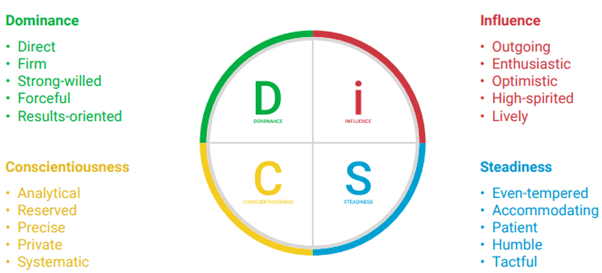
Everything DiSC® is a popular personality and behavior assessment tool used by many organizations worldwide. It is often used to promote self-awareness, communication skills, teambuilding, and conflict resolution. But how accurate is Everything DiSC®? Is it reliable and valid for purposes common within L&D? And if so, what does it measure well, and where are its limitations?
Unlike clinical-grade personality assessments or career assessments, Everything DiSC® is not designed to be used as a clinical instrument for mental health diagnosis or even to measure traits. It is simply intended to measure behavioral preferences in the workplace.
This is not to say that Everything DiSC® is right or wrong, but it has been designed with a different purpose than other common assessments. As such, it should be held to the appropriate standards within that context: reliable and valid for use in workplace settings, but not necessarily as a predictor of job performance.
For more information, check out the rest of the Everything DiSC® Uncovered Series:
- Everything DiSC® Uncovered 1: Everything You Want to Know About Reliability & Validity but were Afraid to Ask
- Everything DiSC® Uncovered 2: Reliability and Validity of Everything DiSC – What Does the Science Say?
- Everything DiSC® Uncovered 3: Common Questions Answered (Simplicity, Barnum, Original Theory)
- Everything DiSC® Uncovered 4: A Balanced Exploration of Reliability, Validity and Practical Application
- Everything DiSC® Uncovered Series 5: Everything DiSC vs “Deeper” tools like Big Five
- Everything DiSC® Uncovered Series Article 6: Strengths and Limitations with Everything DiSC
- Everything DiSC Uncovered Series – Final Conclusions
In this series, we will review published evidence from the Everything DiSC® assessment publisher (available in the Everything DiSC® Manual, Chapter 4) and compare their findings with outside research, expert recommendations, and observations about similar frameworks.
The series will cover What Everything DiSC® Does Well, What Everything DiSC® Doesn’t Do, and How to Supplement Everything DiSC®. Finally, we will share a balanced “verdict” on using Everything DiSC® that we hope you can apply in your own workplace. Let’s get started!

What Everything DiSC® Can’t Do For You: Predictive Validity & Job Performance
“What assessment will help me predict X?” is a question we often hear in the world of L&D. Will this tool allow me to predict job performance? Leadership potential? Sales success? Will it help with retention, engagement, or team productivity? Everything DiSC® shows strong reliability (Article 1) and validity in terms of the constructs it intends to measure (Article 2). But how well does Everything DiSC® predict outcomes?
What Everything DiSC® Claims About Predicting Workplace Outcomes
The Everything DiSC® Manual (chapter 4) does not provide validity evidence in terms of predictive or criterion-related validity. In other words, while the publisher has tested the model’s reliability and validity, the manual presents no data to suggest how well Everything DiSC® scores or styles predict external factors such as job performance. Again, this isn’t necessarily a critique, just a different purpose than assessments designed to evaluate candidates for hire or other high-stakes decisions.
The manual dedicates an entire chapter to demonstrating internal reliability (each of the 8 scales has strong internal consistency with Cronbach’s alphas ranging from .80-.90) and stability (test-retest coefficients between .85 – .88, median angle change of 12° over a two-week span), as well as validity in terms of how well everything DiSC® intercorrelations, Multi-Dimensional Scaling (MDS), and factor analysis support the use of eight scales and the circumplex model. Can Everything DiSC® scores be used to accurately predict or assess job performance? Supervisor ratings? Sales commissions earned? Boxed objectives? Successful leadership? Team productivity?
Again, the publisher provides no direct evidence that Everything DiSC® can predict these outcomes. While some professionals may use Everything DiSC® this way, there is limited research to support widespread use except in a general context.
What Others Are Saying About Everything DiSC® Predictive Validity
Reviews of other DISC-style assessments (including newer models like Everything DiSC®) are quick to point out the lack of predictive validity:
Compared with other models and assessments used for hiring, promotion, and leadership development, Everything DiSC® shows limited, if any, ability to predict job performance. Meta-analytic findings and independent research on the Big Five, Cognitive ability tests, Structured Interviews, and more have found large effect sizes for these other assessment types compared to Everything DiSC and other behaviors assessments. For instance, the broad personality dimensions measured by the Big Five on average predict task-related job performance across all occupations, with conscientiousness showing the highest validity coefficients (Ones et al., 1993)
Many experts review Everything DiSC® as “useful for getting people thinking about behavioral style, but not for assessing who will be successful in a role.” Or, “being comfortable with a fast-paced, direct communication style does not necessarily make an employee higher performing.” In other words, while Everything DiSC® may measure certain preferences and patterns related to behavior in the workplace, these factors alone do not equate to aptitude, experience, motivation, or other factors that drive success on the job.
Even Wiley.com states that Everything DiSC® is better suited for development rather than selection. Their own guide for facilitators and professionals using Everything DiSC® explains that the tool should only be used to help existing employees and teams improve.
Everything DiSC® Shouldn’t Be Used For Decisions Involving:
- Job performance evaluation
- Prediction of reaching sales or production targets
- Sole basis for hiring, promotion, or placement
What Everything DiSC® Can Do For Your Organization
As mentioned earlier, Everything DiSC® has been built and tested for different purposes than some of the assessments above. Everything DiSC® is NOT intended to be a selection tool. Instead, it can be used to drive discussions on behavior and help teams develop better working relationships with each other. When used appropriately, Everything DiSC® has been shown to be reliable and valid for these purposes.
HOWEVER… if your organization plans to use Everything DiSC® in ways that predict or assess aspects of job performance, there are a few options to consider:
Use Everything DiSC® alongside other assessment methods. Many qualified professionals who specialize in Everything DiSC® are also skilled in other assessment or measurement tools. Using Everything DiSC® with performance reviews, structured interviews, job knowledge tests, and other methods can provide a more well-rounded view of employees.
Everything DiSC® as your assessment tool
Everything DiSC®, like any other assessment tool, is only as valuable as the purpose for which it’s used. Everything DiSC® has been shown to be internally reliable and valid in terms of its models and constructs. However, it is not designed or validated as a tool for predicting job performance.
Everything DiSC® is a tool like any other. It has strengths and weaknesses that your organization should understand before investing in everything DiSC® training and materials. When used appropriately, it can lead to powerful and highly productive discussions and better workplace relationships.