DISC is widely recognized and utilized throughout organizational learning and development. But where did the DISC model originate, and why do there appear to be so many variants? How has it changed since its conception almost 100 years ago? Though the original DISC theory has been in the public domain for decades (thus, anyone can create an assessment inspired by it), not all assessments are created equally. There are many resources available to learn about DISC theory, but Wiley stands out in a few key ways. Here’s how and why Everything DiSC® is different from other DISC models.
The History of DiSC® Theory

1928: DISC foundation is set in the public domain
The concept of DiSC dates back to 1928, when American psychologist William Moulton Marston introduced it. During this time, Marston was a colleague of Carl Jung at Harvard University, his alma mater.
Marston believed there were four fundamental emotions exhibited by normal human behavior: Happiness, anger, sadness, and fear. He theorized that these four behavioral responses (D = dominance, I = inducement/influence, S = submission/steadiness, and C = compliance/conscientiousness) were based on one’s reaction to their environment. The vertical axis measures active versus passive behavior, while the horizontal axis measures whether one views the environment as favorable or against them. Marston studied animals and children to substantiate his theory.
Though Marston went on to create the early personality assessment called Attitude Analyzer, his DISC theory never officially became an assessment, nor was it ever copyrighted. So, the foundation of DISC is in the public domain, and anyone can build on it.
1940s: Development of DISC assessment begins
- Walter V. Clarke, an industrial psychologist, developed tools called Activity Vector Analysis and Self-Description. These are forced-choice adjective checklist assessments to measure behavior.
- In 1946, the Cleaver Company modified Clarke’s instruments into one that uses 96 questions in 24 groups of four.
- Between the 1950s–1960s, Dr. John Geier, who was later employed by the University of Minnesota, purchases the rights to use Marston’s framework through Walter Clarke’s daughter and partner with Walter Clarke and others to start Performax Systems. From there, Geier created the Personal Profile System®️ (PPS), the first commercial DiSC® assessment. In doing this, he utilized clinical interviews to better understand and describe the patterns.
1970s–1980s: Fragmentation of DiSC assessments
During this time, Performax (which would later become Carlson Learning then Inscape Publishing and is now part of Wiley’s Workplace Learning Solutions group) continued to develop the tool. Many of John Geier’s partners branched off to create their own spin on the tool:
- Thomas Hendrickson left to start what is now known as Thomas International
- Bill Bonnstetter founded Target Training International and Success Insights
- Andy Lothian created Insights Discovery in 1990
Similar models also started to emerge during this time, including the Myers-Briggs Type Indicator (MBTI, based on Carl Jung’s theories by Briggs and Myers) and social styles.
Everything DiSC®: The Modern Standard
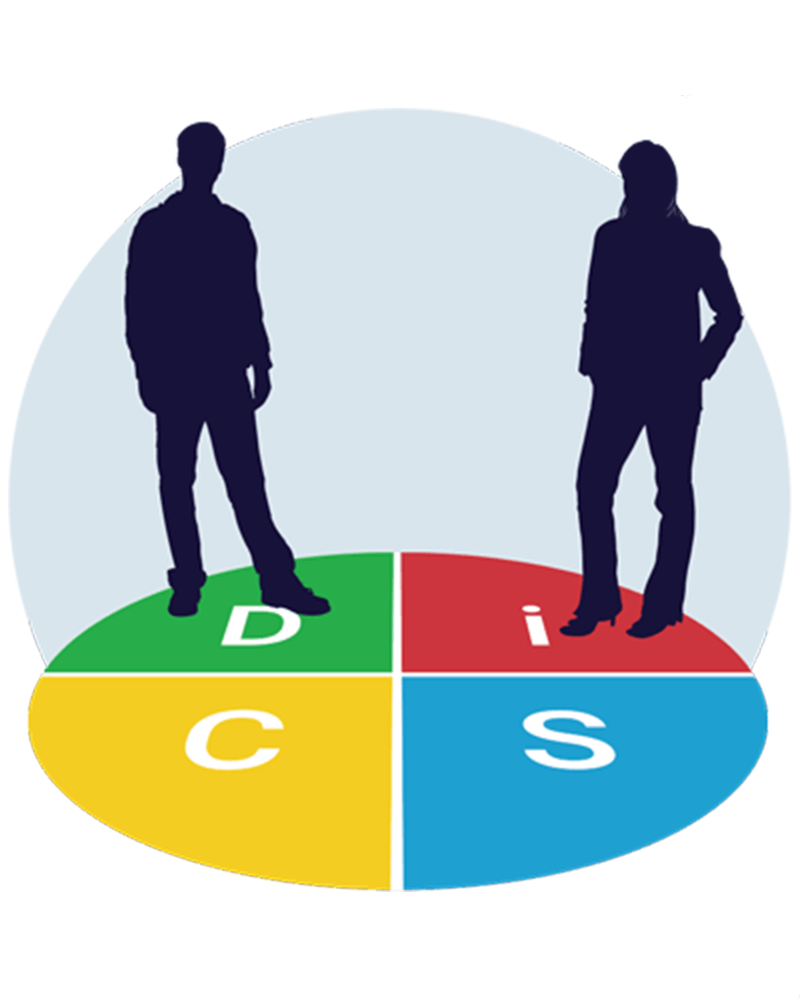
Though many assessments are inspired by DISC, only Everything DiSC® can trace its origins directly from William Moulton Marston to Walter Clarke to John Geier to today. Everything DiSC by Wiley represents the continuous publishing lineage from Marston’s original theory to Clarke’s development of forced-choice adjective assessments to Geier’s original Commercial PPS assessment and Wiley’s Everything DiSC assessment today.
As you can see from above, many of the DISC assessments had a founder who parted ways with John Geier and created their own spin on the model. While some of these providers may still hold the rights to use DiSC or products inspired by DISC in their names, Everything DiSC is unique in a few ways:
Trademarked Everything DiSC and stylized i in DiSC®
Wiley is the owner of the registered trademark Everything DiSC. The stylized i in DiSC® is used purposely to distinguish the trademark from others who may also use DiSC. As you can see in the history, Everything DiSC is the original assessment based on Marston’s theory and has been updated and modified by the same publication lineage for decades (Performax → Inscape → Wiley). Wiley is a 200+ year-old global leader in personal development and education.
Ongoing refinement and research
Everything DiSC has been updated and changed since John Geier’s original PPS assessment in the 1970s. Since then, it has changed into what we now know as DiSC Classic in the 1990s and the online EPIC platform in 2003. Not only has Everything DiSC been around for decades, it has also been continuously updated by the same Wiley team. Other DISC assessments do not have this same extensive history of developmental research and validation.
Uses artificial intelligence
Introduced in 2012, Everything DiSC was the first DiSC assessment to utilize computerized adaptive testing (CAT). Instead of seeing the same questions as everyone else taking the assessment, respondents see questions selected based on their answers to previous questions. Not only does this improve precision by an average of ~12–32% compared to traditional fixed forms, but it also takes less time to complete (approximately 15–20 minutes) and more accurately measures the eight scales (Di, i, iS, S, SC, C, CD, D) and 12 styles along the circumplex.
Everything DiSC touches
Everything DiSC has been utilized by over 10 million learners in over 150,000 organizations across 72 countries and 22 languages. Whether organizations are looking to create a better team dynamic, boost their sales team, or learn how to work better with others, Everything DiSC has been used worldwide. Upon implementation, Everything DiSC reports 97% learner satisfaction and 90% perceived accuracy.
Ready to experience the DISC assessment trusted by 10 million learners worldwide? Explore Everything DiSC® by Wiley and find the right solution for your team.