The Everything DiSC® framework breaks down behavioral styles into four main quadrants – Dominance (D), Influence (i), Steadiness (S), and Conscientiousness (C) – and represents their combination as a simple dot in a circle. The closer your dot is to the center of these quadrants, the easier it is for you to flex across all four styles. DiSC styles on the map’s outskirts indicate a more pronounced, dominant style. There is no “best” style as we are all a combination if all four to various degrees.
Take D’s for example: they prioritize action, independence, and results. Early-stage entrepreneurship favors that instinctive “do whatever it takes” mentality. But as businesses grow, survive, and stabilize, focus shifts to building systems, delegation, leading teams, establishing boundaries, and sticking to a long-term plan. Entrepreneurs who don’t (or won’t) adapt to meet those new demands risk burning out.
How your DiSC Style can lead to burnout
Michael Goldsby’s study, supported by Ball State University and published in the Journal of Small Business Management in 2018, surveyed 400 entrepreneurs across the United States and Australia to discover why entrepreneurs chose to leave their businesses. The article reported two specific findings that contributed to emotional burnout and increased exit risk:
- Role ambiguity – Unclear responsibilities as business scales
- Work-family conflict – Excessive hours and lack of boundaries
Goldsby told Startup Savant Magazine, “Emotional exhaustion was a key predictor of exit intention among small-business owners. They are simply worn out and need a break. So, the company — no matter how successful — will be shut down.”
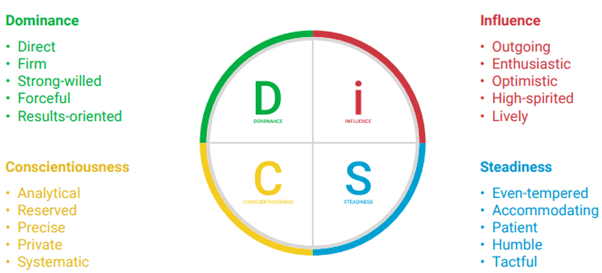
The first step to understanding what your primary DiSC style is and how to better leverage your non-dominant styles to avoid burnout is to take an Everything DiSC Workplace assessment, which represents a unique, state-of-the-art DiSC assessment because of the profound underlying research and the quality of the easy-to-read reporting. See here: https://www.discprofiles4u.com/everything-disc/workplace/
Let’s review how each entrepreneurial DiSC style may experience burnout differently when failing to adapt:
D burning out – Fear of Losing control
Non-adapting D behavior patterns: refusing to delegate, getting aggravated by process/people that move slowly, micro-managing.
How they get burned out: trying to do everything themselves, working all the hours to “get it done right”, getting frustrated with others not working at their pace.
Why they exit: Burned out D’s often reach a point where they feel trapped by their own company. “I can’t take it anymore” mentality. Many will sell, shut down, or take a step back from the business abruptly.
i burning out – Avoiding the tough conversations
Non-adapting i behavior patterns: assuming people will do what they say, struggling to have difficult conversations (performance, conflict), spreading themselves too thin helping others.
How they get burned out: trying to please everyone, guilt from feeling like they let others down, worry from not addressing problems.
Why they exit: Burned out i’s often feel like the journey isn’t fun anymore, or they just don’t have the passion they once did. They may step away or pass the business on to save relationships and energy.
S burning out – Taking on the world
Non-adapting S behavior patterns: not wanting to let down team members who may be underperforming, not wanting to make hard decisions that may risk stability, picking up extra work to help others.
How they get burned out: stress from carrying the emotional burden of others, working long hours people please, shame from letting others down.
Why they exit: Exhausted S’s may quietly shut down at work or show resentment. Many want to “just relax” again after burning out.
C burning out – Trying to make it perfect
Non-adapting C behavior patterns: overthinking, unwillingness to delegate work, not accepting good enough, too much focus on details and not the big picture.
How they get burned out: worrying about everything that can go wrong, working long hours building/sticking to process, getting frustrated when they have to move quickly or accept errors.
Why they exit: Burned out C’s may become cynical about their venture. They may also experience serious health issues. Health often forces high-C entrepreneurs out of business.
If the entrepreneur doesn’t change as the business grows, or they aren’t prepared to act differently, Goldsby said they’ll eventually hit a breaking point. Everything DiSC can help entrepreneurs grow their business without burning out by:
- Helping you identify your natural strengths and weaknesses when you join on as early as possible.
- Stretching your behavior – If you’re a high-D or Dominance color, learn how to delegate and listen more. If you’re a high-C or Conscientiousness color, practice accepting “good enough” deadlines.
- Seeking support from a mentor, coach, therapist, or family business advisor to keep you accountable to your growth journey.
The difference in where your DiSC dots fall on the map reveals why some styles are more naturally equipped to handle the challenges of entrepreneurship. Your dot indicates which one of the four styles you naturally gravitate towards and display most often. If the dot representing your DiSC style is toward or on the outer edge of the circle map, you will find it more challenging to flex into other styles without a lot of practice stretching.
Learn to avoid unhealthy practices
Entrepreneurs who learn about their Everything DiSC style and utilize it as a tool for continuous learning are better equipped to recognize when role ambiguity and work-family conflict are present. They know how to ask for help, where to direct their focus, and when to step back to avoid burning out before they get there.
Reference: Goldsby, M. J., (2018). Antecedents and consequences of small business owner intention to leave the business. Journal of Small Business Management, 56(1), 161-192. Web.